

Before we get into this week’s topic, my first book “CIVILITY OS: An Operating System to Redefine Your Personal and Professional Power” is officially out now and available on Amazon.
If you’re interested in an easy, holistic, and natural way to deepen your closest relationships, solidify your self-integrity, and champion your work to the world, this book may be for you.
Now to the newsletter…
Imagine the following possibilities:
- Titanic (1997): Jack Dawson and the film’s antagonist (Cal) work together to organise a more efficient evacuation process, leading to a significantly higher number of survivors.
- Inception (2010): Cobb convinces his wife (Mal) that they are indeed in a dream and that their children are waiting for them in the real world. They wake up together in reality, reunited with their children.
- The Matrix (1999): Neo convinces the Matrix AI system that humans and machines can coexist in harmony, leading to a peace treaty. The Matrix is used to benefit humanity, with humans and AI working together to create a utopia.
- Star Wars (1983): Luke Skywalker convinces his father (Darth Vader) to reject the dark side through a heartfelt appeal to the remnants of Anakin Skywalker within him. Leading the galaxy into a new era of peace.
Although these are extreme alternative endings, their purpose is to start rewiring your brain’s perceived limitations on what is possible. I wanted to illustrate the often underestimated power of your innate ability to change the world around you.
As I explored in last week’s newsletter, your life around you is a script unfolding by the second, but the outcomes are never fixed.
The truth is:
You cannot change your life by just being confident.
You cannot change your life by just being persuasive.
You need both.
Confidence without Persuasion
I just watched a podcast where the original ‘Wolf of Wall Street’ Jordan Belfort interviewed real estate mogul Grant Cardone. Both individuals are self-proclaimed experts in persuasion. For those who are interested, I will link that here:
Throughout the interview’s non-stop flexing and grandstanding, it became obvious to me that there is a difference between being persuasive and being confident. There is also a fine line between being confident and being cocky.
Firstly, you can never be too confident. Pure confidence, when used strategically, can be incredibly persuasive.
However, if there’s nothing substantial backing up your claims, confidence can devolve into cheap cockiness, and don’t expect a renegade attitude or your status, role, or positioning to compensate and win you any followers.
Conversational cockiness red flags. Are you:
- Overestimating your abilities? Or underestimating those of others?
- Comparing yourself to others?
- Interrupting the other person?
- Looking away while you’re speaking?
- Gesticulating excessively?
- Fidgeting excessively?
- Viewing the other person’s success as your competition?
The last one was particularly potent in the Belfort v Cardone interview. Unfortunately, they missed the opportunity to come together and discuss their skills as one powerhouse titan unit.
Thus, cockiness is off-putting.
Alternatively, you may be a naturally confident person but hate the idea of being persuasive. Translation: people will notice you but will forget you immediately.
In my eyes, this is one of the biggest wasted opportunities.
Clearly, you have something valuable to offer the world – or else you wouldn’t be confident in yourself. Why, then, would you deny yourself and others the opportunity of benefiting from this value and forgo being remunerated for this value accordingly?
In the video above, the gentlemen discussed the challenge of winning over difficult individuals (eg. negative colleagues, cold prospects, etc). Cardone suggested: “I think people need to learn how to talk to people”.
Persuasion without Confidence
With that said, perhaps you do know how to talk to people and are excellent at convincing others to act. You have established rapport, your logic is undeniable, and you have impacted the individual emotionally.
However, your appeal is plagued with:
- filler words (um, err, like)
- a questioning tone
- uncertainty about your own knowledge
- an over-reliance on your notes/script
- a soft, hesitant voice
- closed body language
- quickly agreeing/conforming
- OR any of the cockiness red flags above
Here, people may remember pieces of what you said but they will completely forget your personality. Your message was strong, but your personality was lifeless.
I remember one particular guest lecturer from law school. I remember him for the wrong reasons. Every second word he said was ‘um’. His entire lecture was practically a symphony of ‘umms’, almost melodical. His topic was on legal ethics (I remembered the message) but his delivery detracted from his message and made him extremely unlikeable.
CreatorCavern was established to give you the tools you need to deepen your current relationships, cultivate new ones, navigate the myriad of personalities, and make your voice heard.
We do this for professionals, introverted and highly-sensitive individuals, women in male-dominated industries, artists, creative professionals, people struggling with authenticity, and everyone in between.
I can personally testify from my careers in acting and law that your confidence and persuasion will perfectly combine to form a powerful transformative energy which I call The Power Vortex.
The Power Vortex (How it works)
As long as it is powered up, the Power Vortex is unstoppable.
With your Power Vortex operational, the attainment of any goal or interest is not a matter of ‘if’, but when.
Imagine a 3D tornado-like spiral comprising of two distinct streams of movement. These streams (your momentum) are made from balls of energy (your confidence and your persuasive ability).
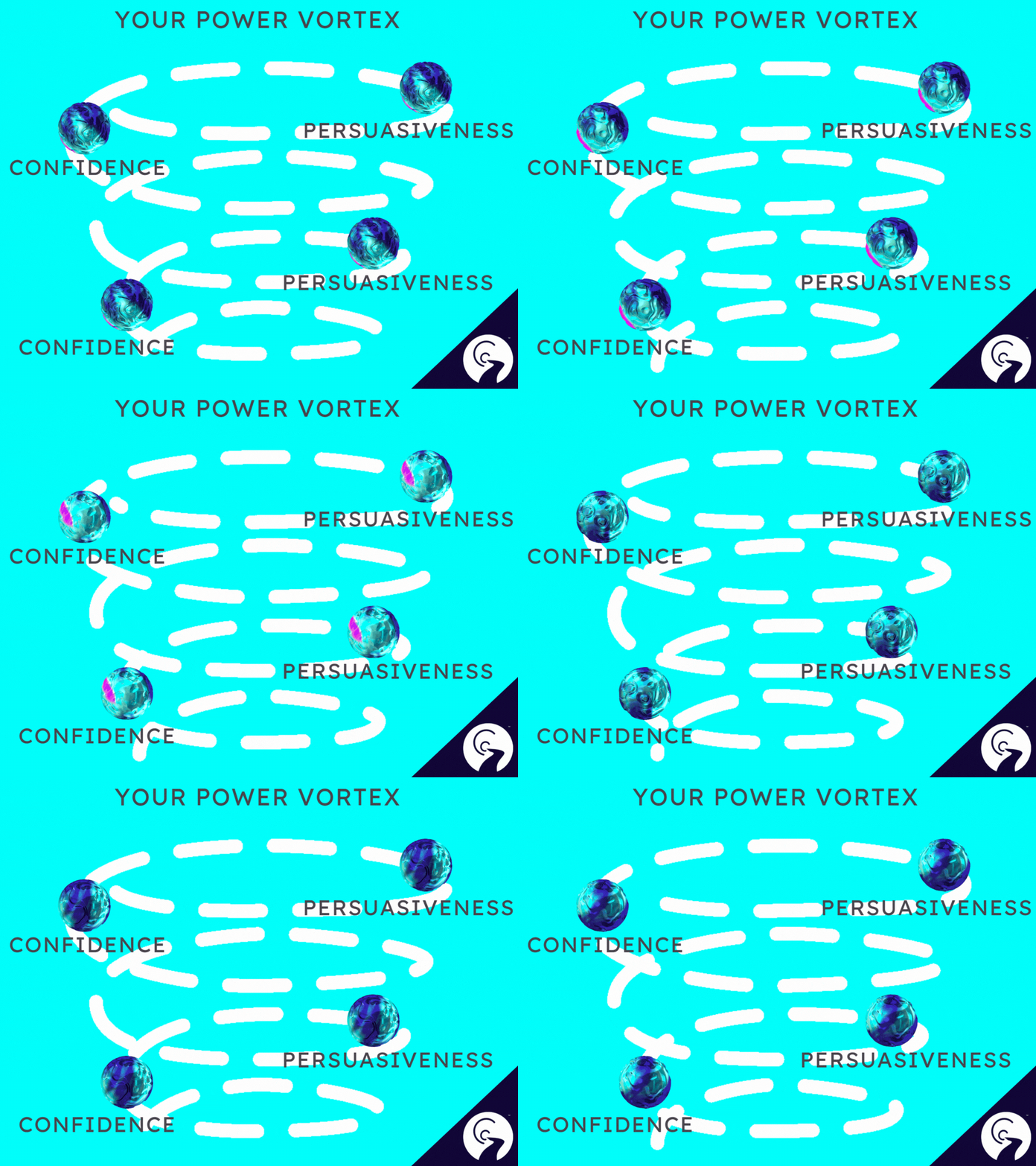
Strengthening your confidence will strengthen your persuasion skills.
Strengthening your persuasion skills will strengthen your confidence.
They go hand in hand.
Thus, the Vortex.
A strong Power Vortex serves to impact the world around you in the following ways:
- to push/nudge people using influence and motivation (in a mutually-beneficial manner), and
- to pull people toward you using intrigue and magnetism.
I mentioned in an earlier newsletter that I activated my Power Vortex for a presentation in law school on the tort of negligence. What I didn’t mention was that empowered presentation of mine actually resulted in me being offered a (highly paid) research fellow position at the University – in Energy and Resources Law remarkably enough!
The Power Vortex works.
Its applications are literally countless. Anything from workplace relations, leadership, entrepreneurship, client management, sales, negotiations, networking events, teaching, goal-setting, dating…
Now it’s time for you to setup your own Power Vortex. There’s no point learning this stuff if you don’t believe in it yourself.
In order to get it moving, your Vortex needs an anchor point from which you can continually draw strength.
- Find a quiet moment.
- Close your eyes. Take a few deep breaths.
- Visualize a moment in your life when you felt incredibly confident and persuasive. It doesn’t have to be a significant event; even a small instance where you felt proud of your ability to express yourself or influence a situation positively.
- Immerse yourself. Recall the place, people involved, sounds, how you felt in that moment, the physical sensations.
- From the core feelings identified, create a short, empowering statement that encapsulates this experience. For example, “I am capable and persuasive when I speak from my heart” or “My confidence commands attention and respect.”
- Pair this statement with a simple physical gesture that you can easily repeat, such as placing your hand over your heart, making a fist, or touching your fingertips together. This gesture will serve as a physical anchor to reinforce the emotional and psychological anchor.
- Practice daily. Allow yourself to be transported back to that memory to reactivate that empowerment.
Can you imagine:
- how Romeo and Juliet could have ended had Romeo held a Power Vortex strong enough to discuss his marriage to Juliet with her family?
- how The Great Gatsby could have ended had Gatsby held a Power Vortex strong enough to express his feelings honestly and directly to Daisy?
- how Hamlet could have ended had he held a Power Vortex strong enough to expose Claudius’ guilt and rallied support?
Self-esteem
This Power Vortex is not self-sustaining.
In the process of getting out of your comfort zone and helping others take action, you will encounter pushback and rejection. If you don’t have solid self-esteem, you’re going to become discouraged quickly, you might quit this altogether, and then you’ve just sold yourself short.
The Power Vortex is sustained by self-esteem. Think of self-esteem as the ‘fuel’ for your Power Vortex.
Daily Challenges for Small Victories yet Big Impact
In future newsletters, we will look more closely at acquiring this ‘fuel’ for your Power Vortex.
We’ll explore various practical daily hacks to help rewire your attitude toward approaching new challenges.
Developing a strong sense of self-esteem (and resulting confidence) will help you withstand the winds of pushback that will inevitably be a part of your new persuasive personality.
Until then, have a strong week ahead,
Ryan.