

Before we get into this week’s edition, I have a special announcement.
I am very excited to share that my first book, “CIVILITY OS: An Operating System to Redefine Your Personal and Professional Power”, has officially been published and released as of this morning, April 29.
It’s been a long time coming—7 months in the making and a whole world of book authorship to acquaint myself with—but it’s now time to share the CIVILITY Ecosystem™ with the world. May it help with strengthening your relationships, championing your personal vision, and securing the best possible opportunities.
CIVILITY OS is out now and can be ordered on Amazon here.
Now let’s get into this week’s topic.
It was a moment I’ll never forget.
Presenting to a large audience in law school, half feeling like I wasn’t yet qualified to be speaking about the tort of negligence, and half feeling the stares of my colleagues and teaching professors.
I must have held my ground well – the University’s leading tort professor greeted me afterwards with: “I’ve been teaching here 15 years and I have never seen anyone speak as good as you have just now”.
Moving into 2025, it appears that social anxiety and imposter syndrome are continuing problems faced by millions worldwide.
Nowadays, due to the rising cost of living and a plethora of other concerns, people are understandably more ‘inward-focused’ on protecting their capital and generally focused on self-preservation what they can gain from an interaction, rather than ‘outward-focused’ and how they can help the other person.
This now raises the bar for building rapport in social interactions, both in our personal and professional lives.
I’m calling on my 8 years experience as a trained actor, 4 years in law, and 3 academic degrees to distill the key strategies and techniques that I personally know are guaranteed to not only help, but also take your personal and professional opportunities to the next level.
TL:DR
1 – Trust Yourself: Use visualisation and mental roleplay techniques to prime yourself into succeeding.
2 – Refine Your Body Language: Open posture, genuine actions, invite conversation, signal openness and approachability.
3 – Learn Persuasion and Negotiation: Enhance any conversation with these principles and techniques that can be used anywhere and at any time.
4 – Cultivate a Positive Presence: Maintain an energetic demeanour, manage stress through composed responses, and exude confidence without arrogance.
55+ Ways to Become Socially Magnetic in Work and Life
This week’s newsletter is a long one. It is a high-level summary of my consulting experience. The aim is to help take you from invisible to invincible.
I’ll lay out 55 ways anyone can become socially magnetic in work and life.
As a reminder, you want to become socially magnetic for these 3 main benefits:
- Enhanced Professional Growth and Higher Paying Clients
- Attract More Meaningful Relationships and Life Opportunities
- Pursue Any Goal With Rock Solid Self-Esteem
Please take some techniques below that resonate and implement them immediately.
I sincerely hope it helps you. Here we go…
#1 – Be Seen More Often
Calling out the introverts here. You can’t make new friends/followers or strengthen existing relationships without making yourself available in public. Whether this be by attending an event, the local cafe/gym, or strategically (intentionally) using social media, you just need to get noticed. You can’t get a promotion, find your next client, or attract a life-changing opportunity if no one knows you exist. It’s time to stop being invisible and start becoming invincible. If you need to polish your social skills, keep reading.
#2 – Fix Your Posture
Impeccable posture subconsciously tells others that you’ve got something important to contribute to the world. In turn, they will feel drawn to you. The main thing you need to do here is ‘pull yourself up’ by visualising a silver cord running from the top of your head down your spine. Imagine gently pulling on this cord from the top of your head.
#3 – Change The Movies You Play In Your Mind
Throughout your life, you have programmed yourself with a specific level of confidence based on the information you have consumed and how you have interpreted it. This programming determines your level of confidence. The good news is you can reprogram yourself for the better. Think of an important situation coming up – how do you feel about it? Change how you think it will play out by infusing your visualisation with intense positivity as you see things going perfectly.
#4 – Develop Active Listening
Actually listen to what the other person is saying. This requires you to be fully present in the moment and refrain from mentally formulating an answer while they’re speaking. Let them finish speaking and don’t interrupt. They will respect you more.
#5 – Be Genuinely Curious About Others
Tied in with Active Listening, this requires you to actually care about the other person’s story. Everyone has something to teach you, no matter their background or experience level. Become interested in learning from their experience – it will make you more likeable, and they may introduce you to someone else.

#6 – Master the Non-Verbals
If you understand body language, you’ll have a significant leg up in any social interaction. Quite literally, it is almost like reading their mind. Look for signs of defensiveness, agitation, deception, insecurity, attraction, and engagement. Use the rule of 3 to confirm your suspicions. Body language is a beast of a skill and you can learn more from me here.
#7 – Avoid Common Ground
This might seem counterintuitive, but if someone says “I coach tennis”, 90% of people will respond with “Oh me too, I coach tennis too!” Congratulations, you’ve just made the conversation about you. It kills any chance you previously had of the person opening up to you. Now you’ve got to work 2x hard to recover.
#8 – Activate the Mirror Neurons!
If I’m frustrated, i’m going to hit the mirror neurons in your brain which will make you angry too. It’s an involuntary response. Considering this, you can leverage skilled vocal intonation and body language to almost ‘jedi mind trick’ any person. I can think of 4 different types of ‘voices’, ranging from playful to analyst, that have specific effects on others.
#9 – Offer Genuine Compliments
Imagine people walking around with a sign above their head saying “make me feel important”. You can never give out too many compliments. Refer to either their physical appearance, their attitude, persona, a recent professional achievement, or a personal skill. It builds rapport instantly, and they may be hearing that compliment for the first time!
#10 – Have Smooth Conversations
Avoid running out of things to say and awkward stalling with the FORD technique – Family, Occupation, Recreation, Dreams.
#11 – Build Rapport Without Speaking
Strategically utilise mirroring techniques to mimic body language. If they’re leaning on one side, wait a few seconds then lean on the same side (like a mirror). If they’re gesticulating frequently, use your hands too! This is highly effective and, if done with tact, they won’t notice a thing yet they’ll feel a stronger connection with you.
#12 – Stay Positive and Optimistic
Yes, you have 15,000 things to get done before the end of the week. Yes, there’s a lot going on in the world. But what’s the alternative – getting weighed down even more by offloading your concerns onto others? Physically dance along to your favourite music everyday for 10 minutes and notice the difference.
#13 – Mimic Their Last Words
Highly effective, yet requires your genuine interest in what they’re talking about. Repeat back to them the last few words of what they’ve just said, posed as a question. It’s an easy way to establish rapport and acquire further information. For example “I’m loving this event, I haven’t been to something this big in years”. You might respond with “In years?”.
#14 – Don’t Be Arrogant
This will undo all the magnetism you’re trying to create. Be confident not cocky. You can never be too confident. Note, you may become a target for criticism from others. Just remember to include a good dose of self deprecating humour to stay humble and people will flock to you.
#15 – Maintain Physical Fitness
It’s not just for your looks. You’ll boost your energy levels and confidence, significantly impacting your social presence. When you’re physically fit, your body is biologically capable of engaging socially on an energetic level. Make a 30-minute daily walk habitual. If you’re short on time, exercise while listening to an audiobook or the news headlines.
#16 – Your Appearance Matters
First impressions count. People will make their minds up about you within 8 seconds of meeting. Exceptional body language cannot compensate for a wrinkled shirt, dirty shoes, or bushy hair. People will judge your appearance as a direct reflection on your character. Check in visually with a mirror every few hours to see how you’re holding up.
#17 – Build Your Sense of Humor
Everyone has innate charisma, whether they realise it or not. It’s probably been buried away since your childhood. Watch a good comedy every week or so. Is there a TV show you love? ‘Who’s Line Is It Anyway?’ and ‘Thank God You’re Here’ are my prime suggestions for inspiring your improvisation skills. A good sense of humor can break the ice and build rapport quickly.
#18 – Leverage Cognitive Biases
Cognitive bias is when there’s an ‘override’ in our thinking – a sort of ‘glitch’ in our mind that causes us to think a certain way. By understanding these biases, we can take advantage of them to ensure our communication has maximum efficacy. One well-known bias is the ‘reciprocity’ bias. Try sharing valuable information that could benefit a colleague. Doing so will make that colleague more inclined to assist or support you in the future. I teach a number of Perception Frames and Behaviour Frames in my consulting.

#19 – Take Social Risks
Your growth won’t come from staying in the comfort zone. Practice the 3-second rule in social settings. Countdown from 3 (acknowledging there’s an opportunity before you), 2 (mentally choosing to engage), and 1 (physically initiating your engagement in that opportunity, eg. walking in the direction of that person). Practice daily and you’ll build mental toughness for any social opportunity.
#20 – Visualize Golden Radiance
An undervalued and powerful technique. Take 20 seconds before entering any social engagement to breathe deeply. Visualise a warm golden light starting to emanate from your chest and see it fill the room you are in. Visualise the interaction being 100% successful – see what that looks like. Then go for it.
#21 – “Yes, and…”
Implement the “Yes, and” technique in discussions. Originating from teachings within improvisation, this can be incredibly fun. It forces your brain to make a contribution that is logical and adds value to any conversation.
#22 – Use People’s Names!
Used strategically, saying their name at the right times not only makes you more likeable, people will subconsciously view you as more authoritative. Use Contextual Affirmation to affirm their contributions, ideas, or feelings within a specific context. Eg. “You’re right, Sarah, approaching it from that angle could lead to a more innovative solution”.
#23 – Avoid Gossip
When someone comes to me with gossip, I know that they are equally likely to be gossiping about me behind my back. Why, then, would I trust that person? Respect confidentiality and people will open up to you more.
#24 – Avoid Filler Words
They dilute the gravitas of speech and make you look insecure and desperate. Filler words include: “umm”, “err”, “like”, “you know” and even cursing “sh##”. Use of filler words generally stems from a lack of self-esteem and self-worth. Your brain fills your speech with such words to give you time to think of what to say next out of fear of being interrupted by the other person. To fix this, you should not start focusing on how you sound when you’re speaking, as engaging speech should be a stream of consciousness. Instead, start eliminating filler words by first taking note of your common filler words and ‘triaging’ them into priorities (start with the ‘umms’, then ‘errs’, etc, then finish with the cursing). You’d be surprised by the results of eliminating your fillers – you’ll have people hanging off your pauses and your every last word.
#25 – Learn to Tell Engaging Stories
Everyone loves a good storyteller – remember how much you appreciated this as a child? Share ideas in an engaging way to quite literally keep the other person coming back for more. Implement a three act structure and follow the hero’s journey where you can. If it works for Hollywood, it will work for you.
#26 – Don’t Be A Time Hoard
Be mindful of others’ time. You’re building your magnetism, so don’t be that person people avoid. Even if you’ve got spare time, appear busy. People are attracted to others who value their time. Keep conversations wholesome and fulfilling, yet concise.
#27 – Exit Conversations Gracefully
Exit by signalling your intention (“I’ve really enjoyed this” or you might shift your stance and step back slightly), offering a compliment (“this has been great”), provide your reason for leaving (if necessary), and finally suggest a follow up (“have I got you on Linkedin?”).
#28 – The Power of Pause
Dynamic silence in conversation can draw people in to you. It is not a sign of uncertainty. You do not have to fill every second with noise. Not only does it give you time to formulate a more thoughtful response, it will add to the weight of your words. Next time you’re asked a question, take a brief pause before answering.
#29 – Acknowledge Everyone in a Group
I once had a lady interrupt me with a group and introduce herself to each person, only to complete ignore me. It was bizarre. You should always make others feel included. Not only is it basic decency, but you never know who might be a big decision-maker. It can be as simple as acknowledging everyone with a nod.
#30 – Maintain a Positive Social Media Presence
Ensure you are reflecting the positive aspects of your personality. Never write anything distasteful, gossipy or slanderous. I would suggest doing a quick review of your profile right now, followed by a Google search of your full name. You may be surprised by the results.
#31 – Deactivate Their Hidden Negativity
Oftentimes, it’s best to call out the elephant in the room. If you are reasonably observational, you can recognise how they might be feeling based on the words they have just said, and you can state that back to them. Eg. “It seems like you’re upset about this”. It serves to neutralise any defensiveness and open up their trust in you.
#32 – Eye Contact
This one is obvious, but I am surprised how many people ignore its importance. If there is one thing that will make me end our conversation early, it’s your wandering eyes. It suggests you are disinterested, distracted, or just socially inept. Try practice Colour Noting by focusing on the other person’s eye color and details. It’ll make it less stressful and more engaging for you.
#33 – Remember Details About People
I remember one event – a reunion with a person I met once in law school, and they started asking “where are you up to on XYZ project coming along?” and “I know you mentioned you wanted to do ___”. I respected him immensely after that. Tom Cruise remembers the names of every crew member on his sets (100+ people). Use the Memory Palace Personalisation technique. I teach this in my consulting, but essentially you associate each room of your home with a person and visualise their personal details as objects in that room. Your living room might be reserved for family members, while your kitchen might be for coworkers. If a coworker mentions running a marathon, you might image a pair of sneakers sprinting around the kitchen on their own.
#34 – Stay Positive and Avoid Complaining
Do not share your hardships with others. 50% of people don’t care about your challenges, and the other 50% of people are glad you have them. People will remember the way you made them feel years after you mentioned your issues with your landlord. Positivity starts with positive thinking, often requiring one to first see an future version of themselves and act in accordance with that vision.
#35 – Encourage Others to Share
If you notice someone being quiet in a group, invite them to share their thoughts. This shows leadership. You’re helping others find their own voice, and you’ve gained a fan in the process.

#36 – Cultivate an Executive Presence
Develop a commanding presence through confident body language, visualization techniques, and a leader’s mindset. It is said that people could sense whenever Marilyn Monroe entered a room solely due to her energetic presence. This can be learned.
#37 – Be a Connector
Introduce people to each other and help them network. It makes you a valuable member of any social circle, and you’ll be seen highly in other people’s eyes. The Law of Reciprocity will likely take effect here and the other person will feel compelled to return the favour for you at a later stage.
#38 – Employ Integrative Bargaining
Focus on negotiation strategies that seek win-win solutions, fostering long-term relationships and mutual satisfaction.
#39 – Use Humor to Disarm Tension
Appropriately used at the right times, it can break the ice, disarm tension, and can even turn a foe to a friend. If you remove the assumption that there is ice to break (there’s not), you are freed up to think more positively. Don’t think X person is cold or out to get you. Instead, choose to believe they love you and then playfully address the obvious in the situation: “Wow, I can feel so much heat coming off you right now. It’s like you’re a mini sun. I should get NASA on the phone”.
#40 – Learn How to Negotiate
Prepare for difficult encounters with the intention of negotiating. You must understand a number of things: your interests and your ideal goal, the other side’s interests, any leverage you may have in the situation, your BATNA (best alternative), and your worst case scenario (the point you would be willing to walk away). Being skilled in negotiating makes life 500% easier to move through, and it becomes easier by practicing the right skills.
#41 – Stop Interrupting Others
Do you like it when people interrupt you? Adopt the 2-minute rule – listen without interrupting for at least 2 minutes. Additionally, practice the ‘hand-holding’ method by physically holding your hands together by clasping them in your lap or holding one hand with the other. It will act as a tactile reminder to listen attentively, reduce impulsivity, and improve self-regulation.
#42 – Use the Power of ‘No’
People feel safe and protected when they can say ‘no’. Most of us have pre-programmed answers to questions like “Have you got a few minutes to talk?”. But we may feel a little more protected when we are asked “Is now a bad time to talk?” Start turning some of your usual questioning into ‘no-oriented’ questions – they’ll feel more at ease and be more likely to share further information.
#43 – Handle Interruptions Gracefully
When you are interrupted, respond with tact. The best response will depend on the context and setting and varies from continuing to speak over the interrupter to stopping altogether and waiting for silence. You might consider whether it’s a formal/informal setting and whether the interruption adds value. A properly handled interruption can leave you looking stronger and more authoritative than before.
#44 – Befriend the ‘King Pins’
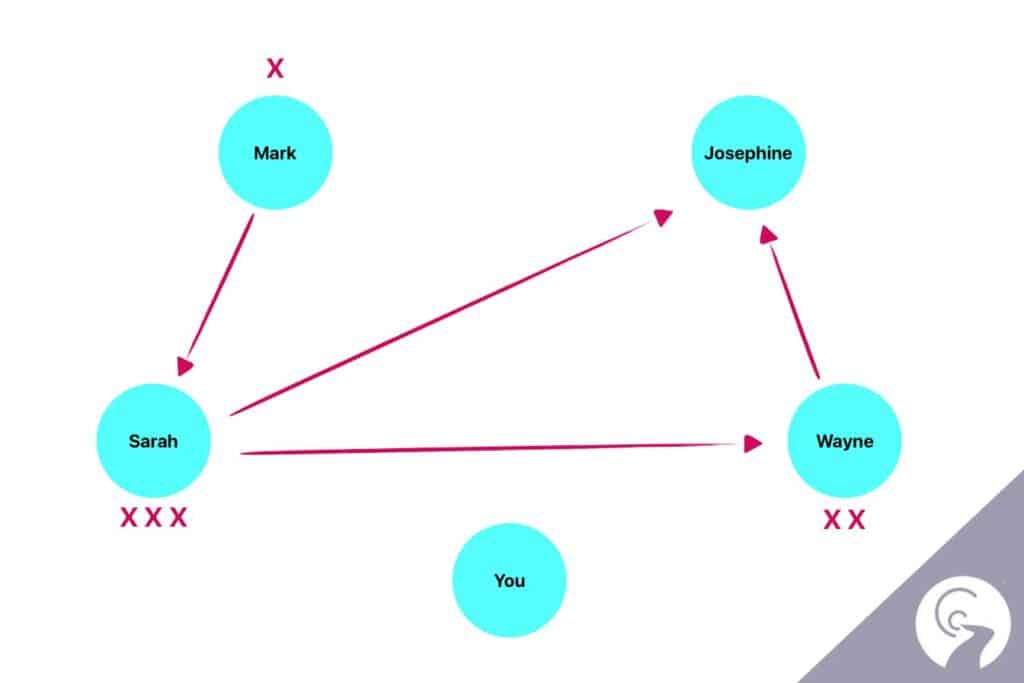
You walk into a group of people. You’d like to make a new friend but you’re short on time. Who do you focus your attention on? Ideally it’s the person with the most influence. But how do you find that out? You mentally draw a Discussion Map for yourself (see an example below). This is how you can find who has the power in any group discussion. You are building social leverage – focus on converting the key influencer and, eventually, they will promote you to everyone they know.
#45 – Diffuse Possible Negativity
One counterintuitive way to gain the upper hand in precarious situations is to list out for the other person all the possible negative feelings they may have of you in that moment. Eg. “It probably feels like you’ve seen everyone in this line of work and there’s no difference between me and everyone else”, “You’re probably thinking that you might not have the money for my services”.
#46 – One Message, One Move
When sending messages to colleagues, friends, clients, prospects online, be concise. Make just one good move in each message. Don’t put too much into one message – it dilutes the potency of your intention and you’ll be less likely to receive a prompt reply.
#47 – Recognize Career Stagnation
Stay alert to signs of stagnation, such as lack of growth opportunities or enthusiasm, and learn strategies to propel your career forward. One way to keep your radar up is to visualise your future self and project your future self into different potential paths to assess whether your current career trajectory aligns with your aspirations. Where might your current path lead you? Pay attention to your emotional response here.
#48 – Develop Verbal Fluency
Enhance your ability to articulate thoughts clearly and compellingly by practising the Chain Association technique. It’s a neat little mental trick, completely novel, highly effective, and easy to use which can be practised in your own time. By simply creating a chain of associations, you will enhance your verbal fluidity, boost your creative expression, and improve your adaptability.
#49 – Laugh at Yourself
Self deprecation is a comedic technique where you willingly engage in modest criticism of yourself. This doesn’t work if you are perceived by others as ‘low status’ – you’ll just be seen as a pathetic joker. So if you have sufficient confidence and authoritative self-worth (through what I teach), self deprecation can be very endearing. Choose light-hearted harmless topics or quirks about yourself that are relatable.
#50 – Reframe Negative Thoughts
If you’re harbouring negativity, people can feel that. Turn negative self-talk into a more positive or realistic light. Whenever you start being self critical, use the Stop Sign technique to visualise a stop sign, and then consciously replace that thought with a positive or neutral one.
#51 – Get A Great Voice
If you have a great voice, you will probably do very well socially. Everything from modulation, intonation, tone, and timbre can be learned. You can use your voice to instil particular emotions in the other person or get away with saying things that you normally wouldn’t be able to. “How can I continue to do that for you on the wage I’m currently on?” can be said with hostility or genuine curiosity.
#52 – Overcome Doubt with Interrogative Self-Talk
Yes it feels nice to pat yourself on the back and say“You can do this!”, however it is not nearly as strong as asking yourself “Can you do this? And if so, how?” This line of questioning forces you to back yourself up and more thoroughly prepare for the challenge ahead.
#53 – Lead from your Heart Center
When you see people walk, they are generally either leading with their head, heart, or gut. Leading from your heart involves imagining yourself being pulled forward from your heart. Visually, your shoulders are down, pulled back and relaxed, your chin is up, and your chest is open. This posture is generally a lot more attractive than someone leading from the head or gut.
#54 – Best Time of Day to Persuade?
Studies have shown you have a better chance of convincing someone earlier in the day or immediately after a break. For even higher chances, you could invite them for a walk beforehand.
#55 – Become an Excellent Improviser
So your confidence is strong, but you’re not quite sure what to say next? One of my favourite classes in drama school was Improvisation. Improv exercises are not only thrilling but also improve quick thinking, adaptability, and spontaneous communication skills. Everyone loves surprises and this skill contributes immensely to your magnetism.
That’s it for this week. Take 2-3 of your favourites and start implementing them from tomorrow onwards. I’m keen to receive your feedback.
As always, if you’d like to organise a call with me for more tailored coaching, you can do so here.
Have a strong week ahead!
Ryan.